

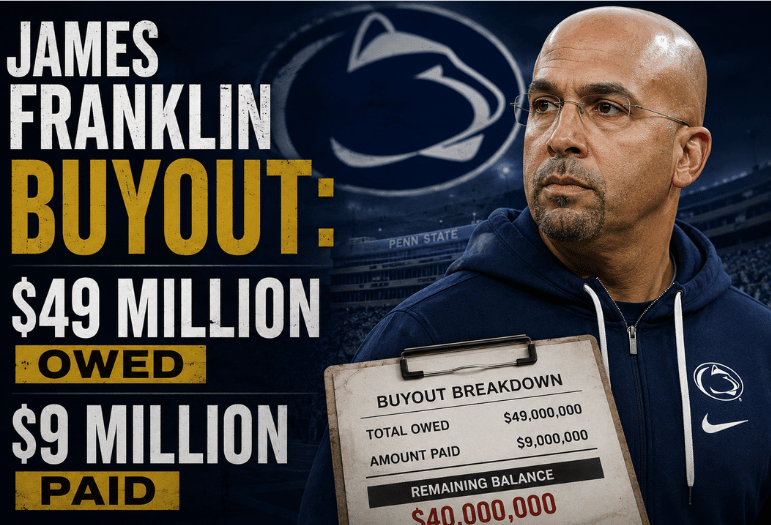
Penn State owed more than $49 million on the James Franklin buyout. What it appears to have paid is closer to $9 million. Between those two numbers sits a five-week stretch in the fall of 2025 that explains how modern coaching contracts really work.
The short version: Penn State fired Franklin on October 12, 2025, with more than $49 million left on his contract. He never collected all of it. Virginia Tech hired him 36 days later. He then settled with Penn State for roughly $9 million, according to ESPN, and signed a new deal worth at least $41.75 million.
One more thing before the numbers. Most pages readers find on this were posted in October 2025 and never dated again, so the figures they show stopped being true in November. Everything below was checked on July 29, 2026.
The deal at a glance
| Item | Detail |
| Fired | October 12, 2025, with the team at 3-3 |
| Penn State record | 104-45 across 12 seasons |
| Contract | 10-year extension signed November 2021, worth up to $85 million, running through 2031 |
| Buyout owed | More than $49 million |
| Annual components | $500,000 base salary, $6.5 million supplemental pay, $1 million insurance loan |
| Reported settlement | About $9 million, tied to his move to Virginia Tech |
| Coaching now | Virginia Tech, hired November 17, 2025 |
| New contract | Five years, at least $41.75 million through 2030 |
| Figures checked | July 29, 2026 |
Key takeaways
- The $49 million headline was accurate on the day of the firing and stale within six weeks.
- Penn State’s obligation was an annual drip through 2031, not a check.
- Getting rehired quickly is what cut the bill, and it cut it by roughly 80 percent.
- Virginia Tech paid Franklin less in year one than it will in year five, which is the shape you expect when a former employer is still on the hook.
What Penn State owed him, line by line
Franklin signed a 10-year extension in November 2021 worth up to $85 million. Four seasons later, at 3-3 after losses to Oregon, UCLA and Northwestern, athletic director Pat Kraft ended it. ESPN reported the termination cost as more than $49 million, the second largest in college football history at that moment.
That total was never a single transfer. Per his contract, Penn State was on the hook each year until 2031 for three separate pieces.
- a base salary of $500,000
- supplemental pay of $6.5 million
- an insurance loan of $1 million
Add those up, and you get about $8 million a year, running six more seasons. Spread that way, a buyout stops looking like a lottery ticket and starts looking like a mortgage the school inherited. It also explains why these deals now shape college football coaching changes as much as won-loss records do.
Why the James Franklin Buyout Shrank to $9 Million
Virginia Tech hired Franklin on November 17, 2025. Five days later, the terms came out: five years, at least $41.75 million, running through 2030. Then the picture changed.
Do the subtraction and the story tells itself. Penn State owed about $49 million. Franklin’s new employer agreed to pay him roughly $42 million over a similar window. What was left was a gap of a few million dollars. ESPN’s Pete Thamel reported on November 18, 2025, that Franklin’s Virginia Tech agreement included a $9 million settlement from Penn State. Local reporting in State College had it first.
One more detail supports that reading. His Virginia Tech salary starts at $6 million in 2026 and climbs to as much as $13.25 million in 2030. That is a steep curve for a coach hired at the top of the market. Back-loading like that is unusual unless something else covers the early years.
Offset clauses, and why five weeks mattered
Most big coaching contracts carry a mitigation or offset clause, and the reason is simple. No athletic director wants to fund a rival program’s payroll. The wording varies, but the effect is consistent: money the coach earns in a new job reduces what the old school still owes. Some deals also require the coach to look for work in good faith.
Not every contract has one. Billy Napier’s Florida deal had no offset at all. Reporting at his October 2025 firing put his buyout near $21 million, with half due inside 30 days no matter where he landed next. Brian Kelly‘s LSU contract went the other way. It obliged him to make sustained efforts to find qualifying employment for as long as the payments ran.
Franklin’s timing was close to ideal. Thirty-six days passed between his firing and his hiring, which meant Penn State’s exposure collapsed almost before the payments began. A coach who sits out a year, by contrast, collects far more from the school that fired him. That same math drives plenty of decisions across the wider sport business, from severance in the front office to release clauses.
Penn State is a state-related university and does not publish its coaching contracts, so the exact offset wording has never been released. The $9 million figure rests on reporting, not on a document you can download.
Where James Franklin coaches now

Blacksburg. He runs Virginia Tech. The Hokies fired Brent Pry on September 14, 2025, owing him about $6 million, and replaced him with the man Pry once worked for. Pry is now Franklin’s defensive coordinator in Blacksburg, which is one of the odder loops the 2025 carousel produced.
Virginia Tech did not treat this as a routine hire. Its Board of Visitors athletics committee reported in April 13-14, 2026, minutes that the hire generated $1.02 million in season ticket revenue within two weeks. That covered 3,000 new season tickets. New ticket revenue rose 173 percent year over year, and the recruiting class climbed from 126th nationally to 21st. Those same minutes set out an “Invest to Win” plan worth $229.2 million across four fiscal years, including a $5.5 million pool for coaching salary increases.
By July 2026, Franklin was at ACC Kickoff in Charlotte, telling reporters his staff had won the offseason. Penn State moved on too, hiring Iowa State’s Matt Campbell on December 6, 2025, on an eight-year deal. Both programs replaced a coach inside two months. Our athlete career profiles track that kind of turnover across sport.
How it stacks up against the biggest buyouts
Franklin’s number was enormous by any standard, and it was not even the largest of its own season. ESPN counted $167.7 million owed to ten fired FBS head coaches in 2025 alone.
| Coach | School | Year | Reported buyout | Reduced by a new job? |
| Jimbo Fisher | Texas A&M | 2023 | $76 million | No, he moved to television |
| Brian Kelly | LSU | 2025 | $54 million | Disputed and litigated |
| James Franklin | Penn State | 2025 | $49 million | Yes, settled near $9 million |
| Billy Napier | Florida | 2025 | $21 million | No offset in the contract |
| Mike Gundy | Oklahoma State | 2025 | $15 million | Not reported |
| Sam Pittman | Arkansas | 2025 | $9.8 million | Not reported |
| Brent Pry | Virginia Tech | 2025 | $6 million | Yes, rehired by Virginia Tech |
Ranked on the gross figure, Franklin sits third all time. Ranked on what the school probably paid, he barely makes the top twenty. That gap is the most misunderstood thing about these numbers. A headline figure quoted a week after a firing is often obsolete by the time anyone repeats it.
Who actually pays for it
Athletics departments do, out of ticket sales, media rights, donations and licensing rather than tuition or state appropriations. Virginia Tech’s board showed the mechanism plainly on February 5, 2026. It approved an $800,000 planning authorization for indoor practice facility work, funded from athletics auxiliary revenues rather than state general funds.
What to watch next
Two threads are worth tracking through the 2026 season. First, whether Virginia Tech’s spending produces results on the field, since the Hokies have now committed $229.2 million to athletics through 2029. Second, whether Penn State’s own books ever confirm the settlement figure, which would move it from reporting to record.
Frequently asked questions
More than $49 million on paper, based on the contract he signed in November 2021. Reported settlement talks cut the amount Penn State paid to about $9 million once he took the Virginia Tech job.
No. ESPN reported a $9 million settlement as part of his Virginia Tech agreement, five weeks after the firing.
October 12, 2025, with Penn State at 3-3. He finished 104-45 in 12 seasons, including 4-21 against AP top-10 opponents.
At least $41.75 million over five years. The deal starts at $6 million in 2026 and rises to as much as $13.25 million in 2030, plus bonuses tied to wins and television viewership.
No. Napier’s Florida deal had none, which is why Florida owed him money regardless of his next job. Offset language is common at the top of the market but far from universal.