

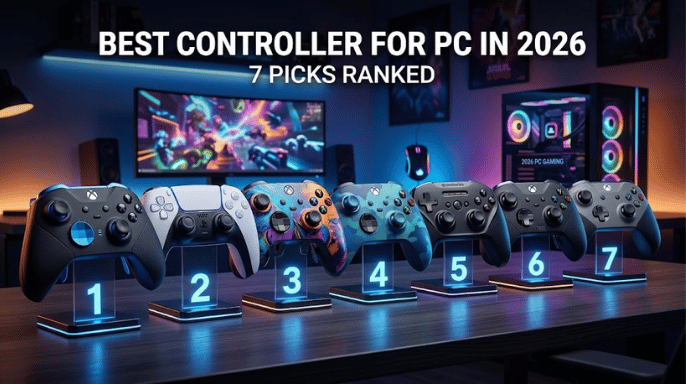
The GameSir G7 Pro is the best controller for PC in 2026 for most people. At $79.99, it brings drift-proof TMR sticks, hall-effect triggers, and 1000Hz polling that used to cost three times as much. The seven pads below are ranked on price, stick technology, battery, weight, and lag, using manufacturer specs and published measurements checked in July 2026. Prices move fast, so every entry lists the official number and the street price.
The 60-second verdict
Spend around $80 on the GameSir G7 Pro if you play a mix of everything on a desk. The $25 GameSir Nova Lite covers platformers and racing. Only competitors need the $199.99 Razer Wolverine V3 Pro 8K PC, andValve’ss $99.99 pad is the couch option for strategy games.
| Model | List price | Street price, July 2026 | Connection | Battery | Sticks | Weight |
| GameSir G7 Pro | $79.99 | $70 to $80 | 2.4GHz, wired, Bluetooth | ~10 hr | TMR | 9.6 oz |
| Xbox Wireless Controller | $64.99 | $45 to $55 | Bluetooth, Xbox Wireless, USB-C | AA cells, ~40 hr | Potentiometer | 9.9 oz |
| Steam Controller (2026) | $99.99 | $99.99, stock limited | 2.4GHz Puck, Bluetooth, USB-C | 35+ hr | TMR | 10.3 oz |
| 8BitDo Ultimate 2 | $59.99 | $48 to $60 | 2.4GHz, wired, Bluetooth | Dock recharge | TMR | 8.7 oz |
| Sony DualSense | $74.99 | $59 to $75 | Bluetooth, USB-C | ~10 hr | Potentiometer | 9.9 oz |
| Razer Wolverine V3 Pro 8K PC | $199.99 | $170 to $200 | 2.4GHz dongle, wired | ~20 hr | TMR | 7.8 oz |
| GameSir Nova Lite | $24.99 | $16 to $25 | Bluetooth, dongle, wired | ~10 hr | Hall effect | 7.2 oz |
Key takeaways
- Magnetic sticks, either Hall effect or TMR, are the single upgrade that stops drift. Under $60, they are now standard.
- A 2.4GHz dongle beats Bluetooth for lag on every pad here. Wired beats both.
- Above roughly $ 10,000, you buy back buttons, swappable parts, and polling rate, not better aim.
- Sony’s pad keeps its haptics and adaptive triggers on PC only over a USB cable.
- Weight matters more than the spec sheet suggests once sessions run past two hours.
The 7 best PC controllers right now
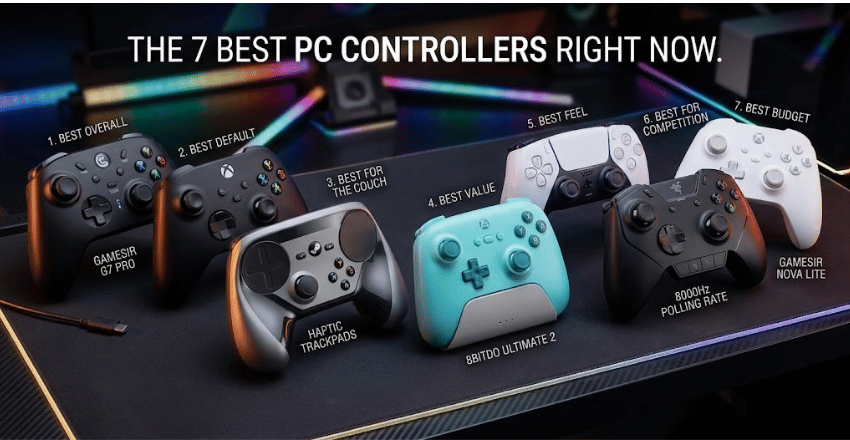
1. GameSir G7 Pro, $79.99, best overall
This is the pad that made the $150 tier look silly. GameSir fits TMR thumbsticks, hall-effect analog triggers, optical facbuttons, and 1000Hz polling into a 9.6 oz body. It still costs less than a stock DualSense. Two lockable back buttons and a gyro round it out.
- Pros: magnetic sticks and triggers, 1000Hz wireless on PC, gyro, roughly 10 hours per charge, swappable stick caps.
- Cons: no built-in dock, average battery life, wireless mode is PC and Android only.
2. Xbox Wireless Controller, $64.99, best default
Every PC game with pad support is built around this layout, so nothing needs configuring. It runs on two AA cells, which sounds dated until you swap them mid-raid instead of plugging in. Windows treats it as the reference device, and Bluetooth pairing needs no dongle at all.
The sticks are old-fashioned potentiometers, so drift remains possible after heavy use. At street prices near $49, that is easier to forgive.
- Pros: universal compatibility, cheap replacements, AA cells, excellent d-pad.
- Cons: no back buttons, no rechargeable pack included, potentiometer sticks.
3. Steam Controller (2026), $99.99, best for the couch
Valve’s pad launched on May 4, 2026, and does something none of the others attempt. Two pressure-sensitive haptic trackpads sit under your thumbs alongside TMR sticks and a 6-axis gyro, which together get close to mouse precision from a sofa. Strategy games, immersive sims and anything with a cursor suddenly work without a desk.
The catch is polling: 250Hz, against 1000Hz on pads costing $60. Valve also leans on Steam Input, so non-Steam titles need extra setup.
- Pros: trackpads and gyro replace a mouse, 35+ hours per charge, four grip buttons, repairable with published parts.
- Cons: 250Hz polling, membrane face buttons, weakest option outside Steam.
4. 8BitDo Ultimate 2, $59.99, best value
TMR sticks, triggers you can flip between hall-effect analog and tactile clicks, 1000Hz polling, and a charging dock in the box. At 8.7 oz, it is one of the lighter full-size pads, and the dock removes the only real chore of owning a wireless one.
- Pros: dock included, switchable triggers, two rear paddles plus two extra bumpers, low weight.
- Cons: stock is patchy, software is Windows-first, RGB ring is decoration.
5. Sony DualSense, $74.99, best feel
Nothing else reproduces the DualSense haptics. Rain, gravel and gunfire all read differently through the motors, and the adaptive triggers stiffen under load. Both features survive on PC over USB-C; over Bluetooth you get plain rumble. Support has widened well pastSony’ss own catalog, though it still tracks closely with our PS5 games and exclusives coverage.
- Pros: best-in-class haptics, adaptive triggers, built-in gyro and touchpad, comfortable grips.
- Cons: potentiometer sticks, roughly 10 hours per charge, full features need a cable.
6. Razer Wolverine V3 Pro 8K PC, $199.99, best for competition
An 8000Hz polling rate, wired or wireless, plus TMR sticks, hall effect triggers with adjustable pull, six remappable buttons and a 7.8 oz shell. That polling figure is genuinely the highest on this list, and Razer ships a carrying case. It is overkill for single-player games and priced accordingly.
- Pros: 8000Hz on PC, lightest pad here, six extra inputs, swappable stick caps.
- Cons: $199.99, no rumble worth the name, wireless is PC-only.
7. GameSir Nova Lite, $24.99, best budget
Hall effect sticks for $25. That is the whole pitch, and it is a good one.
The plastics feel cheap; there is no gyro and no headphone jack, but the sticks will outlast pads costing four times more. Buy two and keep one for guests.
- Pros: Hall-effect sticks, 7.2 oz, three connection modes, works with PC, Switch, and phones.
- Cons: hollow build, no gyro, no audio jack, basic rumble.
What makes the best controller for PC in 2026
Four things separate these pads, and only one of them is brand. Stick technology decides whether the pad survives three years. Connection type decides your latency. Weight and grip shape decide whether you still want to hold it after two hours. Back buttons decide whether you can jump without moving your thumb off the aim stick.
Price barely predicts any of that anymore. A $25 pad can have better sticks than a $75 one. We weighted our ranking toward parts that fail, which is the same approach we take across our gaming equipment reviews.
Everything else is preference. Symmetrical sticks or offset, and how much software you are willing to install.
TMR, Hall effect,a nd the sticks that stop drift
Classic thumbsticks use potentiometers: a wiper dragging across a resistive track. The track wears, the wiper reads noise, and your character walks on its own. That is drift, and it is a mechanical certainty rather than a defect.
Magnetic sticks remove the contact. Hall effect sensors read a magnet’s field, so nothing rubs. TMR sensors do the same job with a different effect and draw far less power, which is why they turn up in wireless pads first.
- Hall effect: no wear, wide deadzone control, slightly heavier battery drain. Found on $25 pads now.
- TMR: same durability, finer resolution near center, lower power. Standard above $60.
- Potentiometer: cheapest, still on the Xbox pad and the DualSense, and the reason both eventually drift.
Are magnetic sticks worth it? Yes, and it is no longer a premium question, since the cheapest pad on this list has them.
Polling rate, dongles, and the lag question

Do controllers lag on PC? A little, and the connection decides how much. Wired is the floor. A 2.4GHz dongle adds a few milliseconds, and Bluetooth adds more on top, which is why competitive players carry the dongle even when Bluetooth would be tidier.
Polling rate is how often the pad reports its position. At 1000H,z that is once every millisecond; at 250Hz, once every four. The gap is real but small next to your monitor refresh. Treat 8000Hz as headroom rather than an advantage you will feel outside ranked play, where players in our esports tournament coverage chase every frame.
- Wired USB-C: lowest latency, no battery worry, cable drag.
- 2.4GHz dongle: near-wired latency, occupies a USB port.
- Bluetooth: most convenient, highest latency, fine for slower games.
Weight, grip and why hand size matters
Pads on this list range from 7.2 oz to 10.3 oz. Three ounces sounds trivial for a four-hour session; on it is the difference between forgetting the pad exists and putting it down.
That is not just comfort talk. A 2026 systematic review and meta-analysis published in Sports Medicine Open pooled six studies covering 553 esports players and put the one-year prevalence of wrist pain at 37%. If you have small hands, favor the Nova Lite or the Wolverine; if your hands are large, the Steam Controller and the DualSense give you more to hold.
What breaks first, and can you fix it
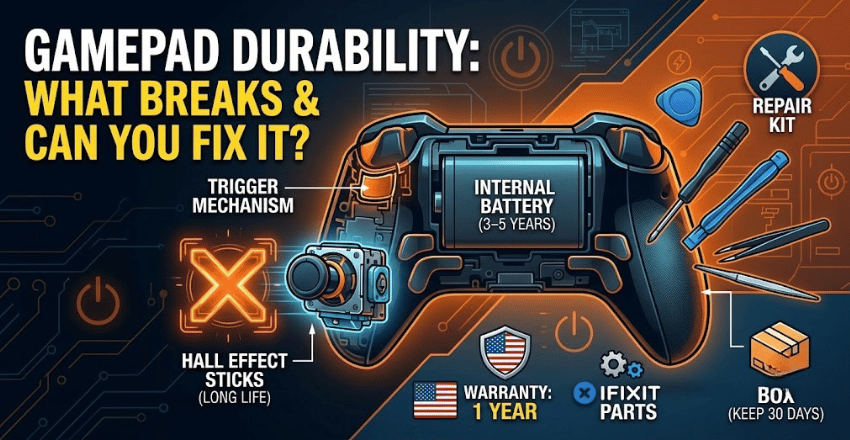
Sticks fail first, then triggers, then the battery. Magnetic sticks push that first failure years out, which reframes the whole budget question: a $60 pad you keep for four years beats two $35 pads.
Repairability now varies wildly. Valve publishes parts and manuals for its pad, and GameSir and 8BitDo sell replacement stick modules. Sony and Microsoft still treat their pads as sealed units, so a drifting DualSense is a warranty claim or a soldering job.
Check the warranty term before you buy. One year is standard in the US, and the retailer, not the maker, is usually the faster route to a replacement.
Whatever you pick, keep the box for 30 days. Stick drift that shows up early is a return, not a repair.
Our pick, and what to buy
Buy the GameSir G7 Pro at $79.99. It has the sticks, the polling rate, the back buttons, and the weight, and nothing else at that price matches all four.
On a $25 budget, take the Nova Lite and spend the difference on games. Couch players should takeValve’ss pad. Anyone competing for money should take the Wolverine. Check the street price before you order, since every pad here has traded below list at least once this year.
Conclusion
The Best Controller for PC is no longer defined by price alone. In 2026, magnetic stick technology, low-latency wireless connectivity, comfortable ergonomics, and reliable build quality matter far more than a premium logo. For most PC gamers, the GameSir G7 Pro offers the strongest balance of performance, features, and value. At the same time, budget buyers can confidently choose the GameSir Nova Lite without sacrificing drift-resistant sticks.
If you prefer immersive single-player experiences, the DualSense remains unmatched for haptics, and competitive players will appreciate the speed and extra controls of the Razer Wolverine V3 Pro 8K PC. Before buying, compare current prices, decide which features you’ll actually use, and choose a controller that fits both your gaming style and your budget rather than simply paying more for features you may never need.
If you want to read more articles, then visit our Equipment Guides category.
Frequently asked questions
The GameSir Nova Lite at $24.99. It has Hall-effect sticks, which is one feature that decides how long a pad lasts, and it works over Bluetooth, a dongle, or a cable.
Yes. Both pair over Bluetooth, and Steam Input maps them automatically. Sony’s pad needs a USB cable for haptics and adaptive triggers, and Nintendo’s Pro pad loses gyro in some non-Steam titles.
No. Bluetooth or a USB-C cable is enough on Windows 10 and 11. The separate Xbox Wireless Adapter exists for lower latency and for older pads without Bluetooth.
Wired or dongle-connected pads with back buttons and magnetic sticks, most often the Razer Wolverine or a Scuf-style custom. Polling rate and paddle count matter more to them than haptics.
Between $60 and $80 hits the point where magnetic sticks, 1000Hz polling, and back buttons all arrive together. Below $30 you still get drift-proof sticks. Above $150 you are paying for competition features.
Over a 2.4GHz dongle, rarely. Over Bluetooth, sometimes, in shooters and rhythm games. Plug in if a game feels floaty and see whether the sensation disappears.
Most keep one alongside a keyboard and mouse rather than instead of it. Racing, platformers, fighting games and third-person action all play better on a pad, and our PC gaming coverage reflects that split.