
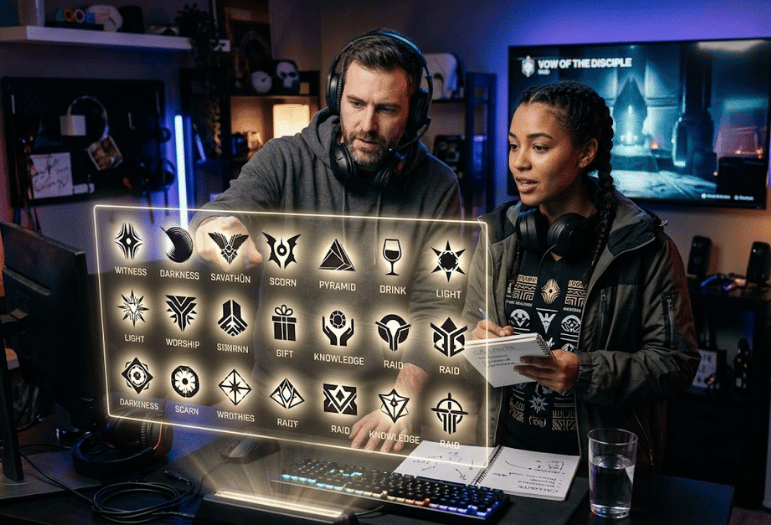
Destiny symbols usually refer to the glyph system introduced in Destiny 2’s Vow of the Disciple raid. These images also appear in Dual Destiny and the Sundered Doctrine dungeon. Knowing their standard names speeds raid communication and prevents confusing LFG callouts.
Destiny 2 uses 26 named Vow glyphs, plus Neutral as an empty reference state. Players use these images to communicate puzzle information during Vow of the Disciple, Dual Destiny, and Sundered Doctrine. Standard callouts help because every player can recognize the same image without inventing a new nickname.
| Detail | What you need to know |
|---|---|
| Main symbol set | Vow of the Disciple glyphs |
| Total reference entries | 27, including Neutral |
| Named glyphs | 26 |
| First major use | Vow of the Disciple |
| Other important uses | Dual Destiny and Sundered Doctrine |
| Best callout method | Use the standard name first |
| Username symbols | Different from raid glyph callouts |
| Current naming caution | Bungie discourages unsupported symbols in Bungie Names |
Key Takeaways
- Learn the standard names before learning community nicknames.
- Vow glyphs appear outside the original raid.
- Neutral represents an empty or inactive glyph state.
- Visual descriptions help when a player forgets a formal name.
- Old Steam username-symbol tricks do not equal current Bungie Name support.
- Fireteams should agree on callouts before starting timed encounters.
All 27 Destiny Symbols and Their Standard Callouts
The Destiny symbols below use the Vow glyph language shared across several activities. Some community names remain popular, but standard terminology reduces mistakes. Use visual descriptions only when someone cannot remember the normal callout.
| Standard callout | Easy visual description | Common alternate callout |
|---|---|---|
| Ascendant Plane | Green upper scene above a purple lower scene | Plane |
| Black Garden | Green landscape above a red lower band | Garden |
| Black Heart | Dark shape inside green rings | Heart |
| Commune | Pyramid below spreading green rays | Prism |
| Darkness | Dark center with white lines around it | Dark |
| Drink | Figure holding a dark cup | Cup |
| Earth | Blue and green globe | World |
| Enter | Door-like shape above a red circle | Door |
| Fleet | Several small black pyramids | Ships |
| Give | Two red hands above a dark shape | Hands |
| Grieve | Pale figure with a dark chest | Grief |
| Guardian | Human figure beneath a Ghost-like shape | Ghost |
| Hive | Dark branching figure with three pale circles | Hive Eyes |
| Kill | White blade pointing into a red circle | Stab |
| Light | Bright center surrounded by colored rays | Light |
| Love | Pink flower-like shape | Flower |
| Pyramid | Large black pyramid | Triangle |
| Remember | Side profile containing a colored brain | Brain or Knowledge |
| Savathun | Witch Queen-style crest | Witch Queen |
| Scorn | White emblem on an orange field | Forsaken |
| Stop | Plain red-orange square | Red Square |
| Tower | Dark tower splitting colored sections | Tower |
| Traveler | White sphere above a blue horizon | Ball |
| Witness | Dark figure below a pale semicircle | Witness |
| Worm | Pale curled worm shape | Snake |
| Worship | Orange figure raising both arms | Pray |
| Neutral | Empty dark ring without an active image | Blank |
You may see Knowledge instead of Remember in older charts. Grief may also appear instead of Grieve. Agree on one term before an encounter so nobody translates callouts while a timer runs.
The easiest method is standard name first, visual description second. A player can say “Remember, the brain symbol” during a teaching run. Later runs can shorten that to “Remember” once everyone recognizes it.
Where These Glyphs Appear in Destiny 2
Vow of the Disciple remains the main source of this symbol language. The raid uses glyph recognition throughout several encounters. Players must identify, remember, compare, and communicate images under pressure.
The game gives players a way to learn the names inside the Pyramid. Approaching the reference glyphs displays their names on screen. This makes the in-game room useful before joining groups that expect fast callouts.
Dual Destiny later reused the same glyph vocabulary for its cooperative puzzles. Partners must communicate symbols while working with different information. Using established names saves valuable time during those sequences.
Sundered Doctrine also brings the Vow-style imagery back into puzzle mechanics. Players familiar with the original raid therefore have an immediate advantage. New players should keep a cheat sheet nearby until recognition becomes automatic.
For more walkthrough-focused coverage, browse GamerLume’s Gaming section. The site also covers puzzle-heavy games with guides like the End Portal walkthrough. Its Azhdaha guide uses a similar quick-reference approach for visual mechanics.
How to Learn Destiny Symbols Faster
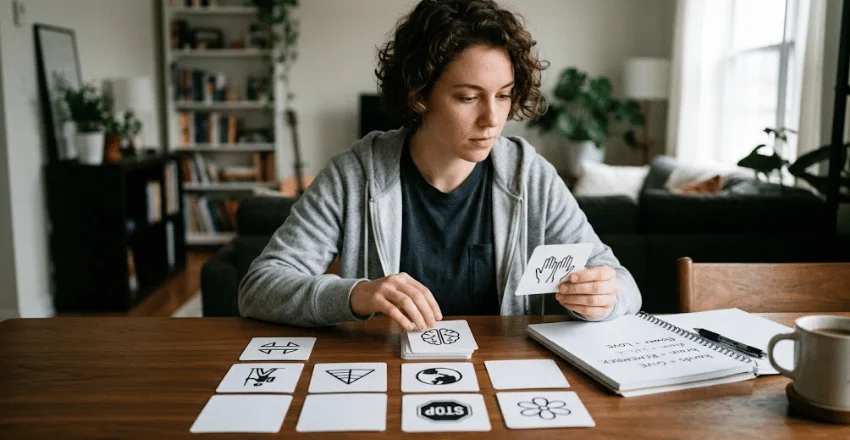
Trying to memorize 27 entries in one sitting usually creates more confusion. Group similar images and learn the clearest ones first. Traveler, Pyramid, Earth, Light, Darkness, Stop, and Witness are strong starting points.
Next, connect harder glyphs with simple visual descriptions. Give becomes “hands,” Remember becomes “brain,” and Love becomes “flower.” These memory aids work because they describe what your eyes already notice.
Practice recognition without reading the answer first. Look at a symbol, say its name aloud, then confirm it. Repeat the missed entries more often than the easy ones.
Finally, practice the names while moving or fighting. Raid callouts rarely happen while everyone stands still. Recognition must become fast enough to survive normal encounter pressure.
Standard Callouts Versus Community Nicknames
Community nicknames can be funny, memorable, and useful inside a regular clan. They become risky when players join Fireteam Finder or an unfamiliar LFG group. A private joke means nothing to someone hearing it for the first time.
The clearest rule is simple: use standard names with strangers. Add a visual description when someone needs help. Save unusual nicknames for groups that already understand them.
Several glyphs create predictable confusion. Hive and Savathun are separate images, despite their related themes. Pyramid and Fleet also differ because one shows a single structure while the other represents several ships.
Black Heart and Love can cause another avoidable mix-up. The first uses a dark central shape surrounded by green rings. Love resembles a bright pink flower instead.
What Does Neutral Mean?
Neutral is the empty glyph state rather than another illustrated concept. That distinction explains why sources sometimes describe 26 symbols and other sources say 27. Both counts can make sense depending on whether Neutral is included.
For a practical cheat sheet, including Neutral is useful. Players may need to describe an empty or inactive panel. Calling it Neutral gives the team a consistent word for that state.
This also prevents “blank” from becoming ambiguous. Blank could mean a panel failed to load or someone cannot see it. Neutral describes the intended empty state more precisely.
Are Destiny Username Symbols the Same Thing?
No, raid glyphs and decorative username symbols are separate topics. Older Destiny 2 PC communities found ways to display icons from game font files in Steam names. That history is why searches for this topic still surface copy-and-paste username guides.
Current Bungie Names follow different rules from those early Steam experiments. Bungie warns that unsupported Unicode, emojis, pictographs, and miscellaneous symbols may create display problems. They can also make player search less reliable.
That means copying an old symbol string is not a dependable current naming method. An icon may fail to display correctly across platforms or interfaces. Use normal supported characters when account search and compatibility matter.
Players mainly seeking decorative icons should therefore check current Bungie naming guidance first. Do not assume a 2019 Steam trick remains supported today. Raid glyph callouts remain the more useful meaning for active gameplay.
Best Callout Strategy for LFG Fireteams
Start every teaching run by checking whether players know the standard symbol names. Do this before the encounter begins. Fixing vocabulary during a timed puzzle wastes far more time.
Use the name followed by one short visual clue when necessary. “Give, hands” is clearer than inventing a long description. “Remember, brain” works for players familiar with an older Knowledge callout.
Keep callouts short once the group settles on terminology. Avoid jokes during critical sequences unless everyone knows them. Extra words make overlapping voice chat harder to understand.
Accessibility also matters when symbols have similar colors or fine details. A clear verbal description can help players who struggle with contrast. Teams should prioritize consistent communication over proving they memorized every label.
Common Symbol Mistakes to Avoid
The most common mistake is mixing official-style names with personal nicknames during LFG runs. Another player may understand the picture but not your phrase. Standardizing the vocabulary removes that unnecessary problem.
A second mistake is confusing related glyphs. Savathun is not Hive, Fleet is not Pyramid, and Black Heart is not Love. Learn these pairs together so their differences become obvious.
Players also sometimes rely too heavily on one static chart. That helps with study but not with fast recognition. Test yourself until you can identify common glyphs without scanning every row.
The last mistake is treating every search result about symbols as a raid guide. Some pages discuss usernames, faction logos, or broader iconography. Confirm which type of symbol you need before following instructions.
Why the Symbol System Matters Beyond One Raid
The glyph system became more useful because Bungie reused it across multiple activities. Knowledge gained in Vow can carry into later cooperative puzzles. That makes learning the vocabulary more valuable than memorizing one encounter solution.
The symbols also create a shared language between players. A short callout can communicate an image, location, or instruction immediately. That efficiency becomes important when several people speak during combat.
Reuse also gives returning players a useful recognition advantage. Someone who learned Vow years earlier can recognize familiar mechanics elsewhere. The exact puzzle may change, but the visual vocabulary stays recognizable.
For another example of visual problem solving, GamerLume’s End Portal guide breaks a multi-stage game puzzle into smaller actions. The Gaming category also collects current guides across other games. Those resources follow the same quick-reference approach used here.
Frequently Asked Questions
What are Destiny symbols?
Destiny symbols are commonly the Vow of the Disciple glyphs used in Destiny 2 puzzle mechanics. The main reference contains 26 named images plus Neutral. These callouts later appear in activities including Dual Destiny and Sundered Doctrine.
How many Vow of the Disciple symbols are there?
You will commonly see 27 entries on complete cheat sheets. That count includes 26 named glyphs and the Neutral state. Sources that exclude Neutral may describe the set as 26 named symbols.
Do I need to memorize every glyph?
No, you can keep a reference image nearby while learning. Fast recognition becomes more useful during timed encounters. Start with obvious glyphs, then practice similar-looking pairs.
Are the Dual Destiny symbols different?
Dual Destiny reuses the Vow glyph vocabulary rather than creating a separate symbol set. This is why experienced Vow players often recognize its callouts immediately. Partners still need clear communication because each player receives different information.
Can I put Destiny icons in my Bungie Name?
Old Steam methods existed for displaying game-font icons in player names. Current Bungie guidance warns against unsupported miscellaneous symbols and pictographs. They can cause display or player-search problems.
What is the easiest way to remember the callouts?
Pair each formal name with one obvious visual cue. Remember can become “brain,” while Give can become “hands.” Drop the extra description after the team recognizes the standard term.
Final Takeaway
Learn the standard Vow names before worrying about clever community nicknames. That approach works better with unfamiliar teammates and carries into multiple activities. Keep a cheat sheet open until recognition becomes automatic.
The biggest distinction is between gameplay glyphs and old decorative username tricks. Raid callouts remain useful across current Destiny 2 content. Unsupported name symbols may behave differently under Bungie’s modern account system.
For more game walkthroughs and mechanic guides, continue through GamerLume’s Gaming section. Practice the difficult glyph pairs before your next fireteam starts. Clear callouts usually save more attempts than memorizing elaborate nicknames.