


Munetaka Murakami plays first base for the Chicago White Sox, who signed him out of Japan on a two-year, $34 million contract in December 2025. Through 70 games, he is batting 240 with 22 home runs, 48 RBIs, and a .922 OPS. A Grade 2 hamstring strain wiped out six weeks of his rookie year. His return came on July 10, and Chicago now sits in first place in the American League Central.
Below is the whole file. Start with the posting that brought him over, then what the deal really cost, the 56-homer season in Tokyo, and where the numbers stand on July 29, 2026.
| Detail | Fact |
| Born | February 2, 2000, Kumamoto, Japan |
| Team and position | Chicago White Sox, No. 5, first base and DH |
| Bats and throws | Left and right, 6-foot-2, 213 pounds |
| Contract | Two years, $34 million, signed December 2025 |
| Former club | Tokyo Yakult Swallows, 2018 through 2025 |
| Career in Japan | 892 games, 246 home runs, .270 average, .951 OPS |
| Best season | 2022: .318 average, 56 home runs, 134 RBIs |
| 2026 line | 70 games, .240/.382/.541, 22 home runs, 48 RBIs |
Key Takeaways
- Chicago guaranteed $34 million over two years, and Yakult collected a release fee on top of that.
- He homered in his major league debut on March 26, 2026, and shared the big league home run lead through early May.
- Six weeks on the injured list, not the strikeouts, explain why his counting stats trail Kazuma Okamoto’s.
- A .240 average hides an 18.4% walk rate. That is the number to watch.
The Two-Year, $34 Million Bet Chicago Made
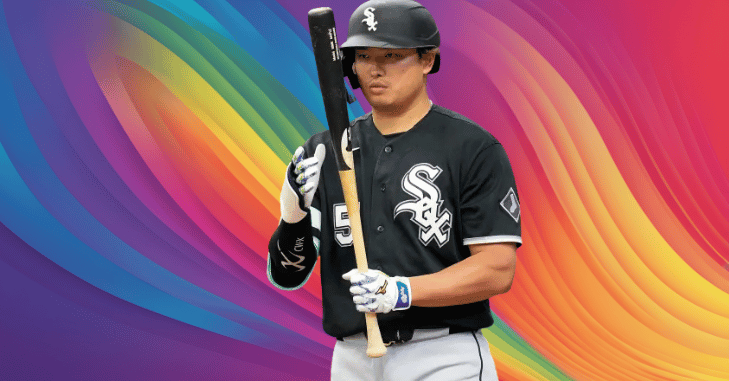
Yakult posted him in November 2025. Under MLB’s Japanese posting system, that opened a 45-day window in which all 30 clubs could negotiate with him. Sign nobody inside those 45 days, and he goes back to Tokyo for another year.
Munetaka Murakami: Nobody rushed. ESPN’s Kiley McDaniel had projected five years and $80 million. Front offices kept circling one figure instead, a 72.6% in-zone contact rate, which is a polite way of saying he swings through strikes. Chicago’s agreement landed in late December 2025, days before the window shut, worth two years and $34 million.
His old club got paid separately, and that part rarely makes the write-ups. MLB’s release fee runs in tiers on the guaranteed money.
| Guaranteed money | Release fee rate | On a $34 million deal |
| First $25 million | 20% | $5,000,000 |
| Next, $25 million, up to $50 million | 17.5% | $1,575,000 |
| Anything above $50 million | 15% | Nothing |
Work the tiers, and the Yakult Swallows cleared roughly $6.58 million, which puts Chicago’s real outlay near $40.6 million. Judge the signing on that number, not the headline one.
Munetaka Murakami Stats in 2026, Split by the Injury
The season line reads .240/.382/.541 with 22 home runs and 48 RBIs in 70 games. Split it at May 29, the afternoon he pulled up running to first base, and the shape changed.
| Stretch | Games | Home runs | RBIs | Average |
| March 26 to May 29 | 57 | 20 | 41 | .240 |
| July 10 to July 27 | 13 | 2 | 7 | .239 |
In 304 plate appearances, he has walked 56 times and struck out 98. That works out to an 18.4% walk rate against a 32.2% strikeout rate. Everyone counts the strikeouts. The walks are why his OPS+ reads 156, meaning his bat has been 56% better than league average after adjusting for park and era.
Rookies rarely control the strike zone like that, and it survived a six-week layoff: 12 walks in 13 games since he came back. If you track the AL Central through our sport coverage, watch the walk rate before the batting average.
The 56-Homer Season and The Seven Around It

One year made his name. In 2022, aged 22, he hit .318 with 56 home runs and 134 RBIs. That led the Central League in all three categories, as NPB’s own 2022 batting table still shows. No hitter in Japanese professional baseball had ever taken a Triple Crown that young.
Behind that single season sits the rest of the record, and it is the more useful half.
- 2019, aged 19: 36 home runs and 96 RBIs, with a .231 average and 184 strikeouts.
- 2020: a .307 average and a 1.012 OPS across a shortened schedule.
- 2021: 39 home runs, 112 RBIs, 106 walks.
- 2023 and 2024: 31 and 33 home runs, with the average sliding to .256 and then .244.
- 2025: 22 home runs in only 56 games.
Eight seasons, 892 games, 246 home runs, a .270 average and a .394 on-base percentage. Nothing about the White Sox version is a surprise, then. Huge power, heavy walk totals, and strikeouts to match—all of it visible in Tokyo years ago. Careers like this one read better in a single block, which is what our athlete profiles archive is for.
Why a Grade 2 Hamstring Strain Cost Him Six Weeks
He tore it on May 29 against Detroit, beating out a double-play grounder. It came back as a Grade 2 strain of the right hamstring. Nobody saw him in another big league game until July 10.
Six weeks is a long absence for that injury. A 2019 study in the Orthopaedic Journal of Sports Medicine logged 2,633 hamstring strains in professional baseball from 2011 through 2016. Drawing on MLB’s own Health and Injury Tracking System, it found the mean time missed was 14.5 days. Infielders accounted for 37.5% of those injuries, and more than half happened on the bases, most often running home to first.
So his layoff ran roughly three times the average. The same research put the recurrence figure at 16.3% in the majors and singled out Grade 2 and Grade 3 strains as the ones that cost significantly more time. That risk sits under every sprint he takes in August.
Rookie of the Year: Murakami Against Kazuma Okamoto
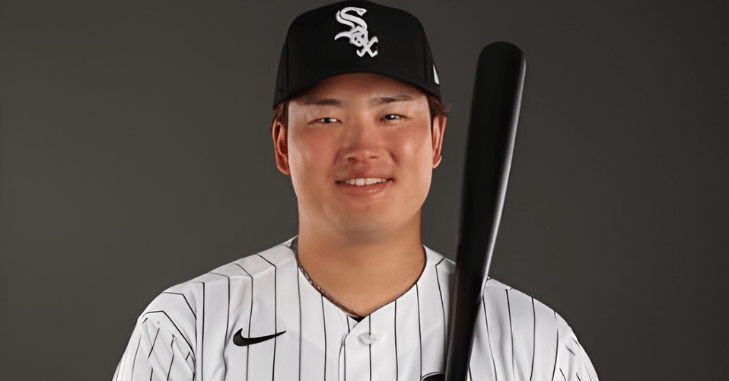
Two NPB imports lead all American League rookies in home runs. They are nowhere near each other in anything else.
| Rookie | Team | Home runs | RBIs | Average | OPS |
| Kazuma Okamoto | Toronto | 23 | 65 | .224 | .744 |
| Murakami | Chicago White Sox | 22 | 48 | .240 | .922 |
| Samuel Basallo | Baltimore | 16 | 46 | .241 | .756 |
Okamoto owns the counting stats because he stayed healthy. Per plate appearance, the race is lopsided the other way, since a .922 OPS against a .744 OPS separates a middle-of-the-order bat from a useful one. Voters reward playing time, though, so the 30-odd extra games Okamoto has banked may settle the award.
The two-year, $34 million bet Chicago made

Chicago is 53-46 and a game clear of Cleveland. This is no longer a rebuilding roster, and Munetaka Murakami is the reason the lineup changed shape. He made the All-Star roster in July as an injury replacement, then took his cuts in the Home Run Derby in Philadelphia. Three months earlier, nobody outside Chicago saw either coming.
Three things decide how the season reads in October.
- Does the hamstring hold up through August travel and September doubleheaders?
- Can he lift that in-zone contact rate? Nothing else in his game needs fixing.
- Do the White Sox hold the division and hand him a playoff stage in year one?
Conclusion
Munetaka Murakami’s first MLB season has already shown why the Chicago White Sox invested in one of Japan’s most feared power hitters. Even after missing six weeks with a hamstring injury, he has continued to produce elite power, exceptional on-base numbers, and the disciplined approach that made him a star with the Tokyo Yakult Swallows. His 56-home-run Triple Crown season in Japan was no fluke—it laid the foundation for a successful transition to Major League Baseball.
As the 2026 season enters its final months, Murakami’s health will be the biggest factor in determining both his Rookie of the Year chances and the White Sox’s playoff hopes. If he stays on the field and maintains his outstanding plate discipline, he has every opportunity to become one of MLB’s premier sluggers. For the full picture, read Egbuka.
FAQ
The Chicago White Sox. Chicago signed him in December 2025, and his debut came on March 26, 2026, at Milwaukee, where he homered.
Two years and $34 million guaranteed, plus a release fee of about $6.58 million that MLB’s tiered formula sends to the Tokyo Yakult Swallows.
246 across eight seasons, including 56 in 2022. That year also brought a .318 average and 134 RBIs, the Triple Crown.
He turned 26 in February. Kumamoto, on the southern island of Kyushu, is home, and he signed with Yakult as an 18-year-old in 2018.
He has the better bat and the weaker case. Six weeks on the injured list cost him about 30 games on Okamoto, so a loud August is probably the price of the award.