

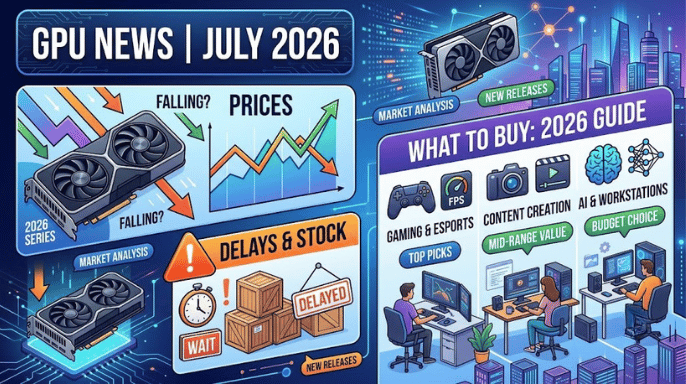
The short version of this month’s GPU news is blunt. Almost nothing new is launching, and almost everything already on shelves costs more than it did in January. Memory, not silicon supply, is doing the damage.
As of July 28, 2026, no new desktop graphics card generation is coming this year. Nvidia shelved its RTX 50 Super refresh, Intel killed the Arc B770, and AMD pushed its next architecture into 2027. Street prices sit anywhere from 5% to 100% above official pricing, because memory now dominates what a card costs to build.
Where graphics card prices stand right now
Tom’s Hardware tracks the lowest US listing for every current card daily. Its July 27, 2026 snapshot makes for ugly reading. One card in the entire desktop lineup sells under its official price, and it is the smallest-memory model on the list.
| Card | MSRP | Street price, July 27, 2026 | Over MSRP |
| Nvidia RTX 5090 | $1,999 | $3,999 | +100% |
| Nvidia RTX 5080 | $999 | $1,256 | +26% |
| Nvidia RTX 5070 Ti | $749 | $949 | +27% |
| Nvidia RTX 5070 | $549 | $629 | +15% |
| Nvidia RTX 5060 Ti 16GB | $429 | $569 | +33% |
| Nvidia RTX 5060 Ti 8GB | $379 | $374 | 1% under |
| Nvidia RTX 5060 | $299 | $339 | +13% |
| Nvidia RTX 5050 | $249 | $289 | +16% |
| AMD RX 9070 XT | $599 | $699 | +17% |
| AMD RX 9070 | $549 | $639 | +16% |
| AMD RX 9060 XT 16GB | $349 | $448 | +28% |
| AMD RX 9060 XT 8GB | $299 | $359 | +20% |
| Intel Arc B580 | $250 | $309 | +24% |
| Intel Arc B570 | $219 | $229 | +5% |
Two patterns jump out of that table. Cards with more video memory carry the fattest markups, and the 8GB models are the only ones sitting near sticker. That is no coincidence. If you are pricing the rest of a build, our equipment reviews and buying advice cover the parts that have not moved nearly as much.
One card in fourteen under MSRP is not a functioning market.
Key takeaways
- No new desktop generation arrives in 2026. That gap has not happened in roughly 30 years.
- Street prices run 5% to 100% over MSRP, with the RTX 5090 near $3,999.
- Memory is the cost driver, not the graphics chip. One 3GB GDDR7 module now runs $60 to $70, roughly triple its 2025 price.
- Nvidia’s RTX 50 Super refresh, Intel’s Arc B770 and AMD’s next architecture have all slipped or died.
- A 2021 card, the RTX 3060 12GB, is back at $339.99, which is above its original launch price.
Why memory became the whole story

Gaming cards and AI accelerators buy from the same short list of suppliers. Samsung, SK hynix and Micron together account for most of the world’s DRAM output, and data center orders now outbid every other customer for it.
Scale explains the behavior. Nvidia’s fiscal 2027 first-quarter results, filed with the US Securities and Exchange Commission, put that split in plain numbers. According to the filing, data center revenue reached $75.2 billion in the quarter that ended April 26, 2026, against total revenue of $81.6 billion.
Everything else the company sells, PCs and consoles and robotics included, came to $6.4 billion. Gaming no longer gets a line of its own.
Board partners feel that imbalance in the bill of materials. A single 3GB GDDR7 module costs $60 to $70 today, against about $20 for the older 2GB part. Fitting 24GB of the newer memory to one card runs close to $500 in components, where the same job cost roughly $160 a year ago.
Contract prices are still climbing. TrendForce expects conventional DRAM contract prices to rise another 13% to 18% quarter over quarter in the third quarter of 2026, with NAND up 10% to 15%. Memory makers have already sold out their 2026 allocations for conventional chips.
Nvidia skipped a year, then brought back a 2021 card
Nvidia has launched no new desktop GeForce generation in 2026, breaking a streak that ran about three decades. An RTX 50 Super refresh was supposed to fill the year. Partners were told in January that it had been postponed indefinitely, and the 18GB and 24GB variants that would have fixed the lineup’s memory problem never shipped.
So the company went backwards instead. A Gigabyte RTX 3060 12GB turned up on Newegg on June 29, 2026 at $339.99, ten dollars above what the card sold for at its 2021 launch. Jensen Huang floated the idea at CES 2026, calling a revival of older cards built on trailing-edge nodes a good idea. It works because those chips and their GDDR6 memory sit outside the worst of the squeeze.
Supply is being throttled at the same time. Partners describe cuts of 20% to 40% on RTX 50 allocations. A second kit price increase then landed on July 25, 2026, covering current Blackwell cards and the revived RTX 30 parts alike. Our gaming news and release coverage follows how this feeds through to the games themselves.
AMD raised kit prices and trimmed the lineup
AMD moved in July too, lifting the price of the GPU and memory kits it sells to board partners by about 10%. Sapphire, ASUS, XFX and ASRock all buy those bundles, so the increase reaches shelves gradually as older stock clears rather than overnight.
- AMD is favoring RX 9070 XT production over the plain RX 9070, and the cheaper card may be cut entirely.
- RDNA 5, the next Radeon architecture, has slipped to the second half of 2027 at the earliest, with some partners pointing to 2028.
Intel stopped competing in gaming.
The Arc B770 is dead. Intel’s 16GB Battlemage card, built on the BMG-G31 chip with 32 Xe cores, would have landed near $400 and undercut both rivals on price. Memory costs, validation, drivers, and marketing did not pencil out against a discrete graphics share sitting under 1%.
That chip lives on as the Arc Pro B70, a 32GB workstation card. Discrete gaming was also stripped out of the Xe3P Celestial family, which now aims at data center work, so Battlemage remains Intel’s newest gaming silicon. Its B580 sells around $309 against a $250 launch price, which tells you how thin the budget end has become.
The GPU news timeline behind these prices

Five decisions between January and July built the market you are shopping in today.
- January 2026: Nvidia tells partners the RTX 50 Super series is delayed indefinitely.
- April 2026: Intel’s Xe3P Celestial family loses its discrete gaming cards.
- May 2026: Nvidia issues the year’s first kit price increase, starting with the RTX 5090.
- June 2026: The RTX 3060 12GB returns to retail at $339.99, five years after it first shipped.
- July 2026: AMD lifts kit prices about 10%, and Nvidia follows with a second increase on July 25.
What to buy and what to skip
Shopping in this market is mostly about dodging the worst markups rather than finding a bargain.
- Closest to sticker: the RTX 5060 Ti 8GB at $374 and the Arc B570 at $229.
- Defensible: the RTX 5070 at $629 and the RX 9070 XT at $699, both under 20% over MSRP.
- Skip: the RTX 5090 at $3,999 and the RTX 5060 Ti 16GB, as it carries a 33% premium.
- Skip the revived RTX 3060 as well. It costs more than a faster RTX 5060 and lacks frame generation.
Play mostly competitive shooters at 1080p? A $300 card is plenty, and our esports tournament coverage is a decent guide to what the pros actually run.
If none of that appeals, a console is the cheaper route this year. The PS5 exclusives worth playing have not slowed down, and Sony’s hardware pricing has held far steadier than the PC market’s.
How much VRAM you actually need

Video memory is the one spec worth paying up for right now, which is exactly why it costs so much. At 1080p, 8GB still handles most games at high settings. Push to 1440p with ray tracing on and 12GB becomes the floor, while 16GB gives you room for the next few years.
Retail pricing has caught up with that reality. Every 16GB card in the table above carries a bigger markup than its 8GB sibling. On the RTX 5060 Ti, the gap between the two versions has stretched to roughly $195.
Buy the memory now if the budget stretches. You cannot add it later.
If you want to read more interesting articles then visit our Gaming category.
FAQ
No. Memory contracts get set quarters ahead, and DRAM contract prices are still forecast to climb through the third quarter. Conventional memory allocations for 2026 are already sold out, which puts real relief in 2027 at the earliest.
Not a new generation. The RTX 50 Super refresh is shelved, and the RTX 60 series built on the Rubin architecture is expected in the second half of 2027. Fresh listings are limited to revived RTX 30 cards on older nodes.
If your current card still runs your games, wait. If you need one, buy the cheapest card that clears your resolution target, and buy it sooner rather than later. Kit prices have gone up twice already this year, so waiting has cost money instead of saving it.
Nvidia planned an RTX 5070 Super with 18GB plus RTX 5070 Ti and 5080 Super cards carrying 24GB. All three needed 3GB GDDR7 modules, the exact component whose price tripled. The refresh went on indefinite hold in January 2026, and CES 2027 is the earliest realistic window.
Yes, and sharply. Used RTX 30 and RX 6000 cards have held their value all year, and the relaunched RTX 3060 12GB at $339.99 effectively reset the floor for that tier. Check completed sales rather than asking prices before you buy or sell one. Pick your resolution, set a tight budget, then buy the cheapest current card that clears both. Nothing arriving before 2027 is going to rescue you from today’s prices, so the sensible move is to buy what you need and stop refreshing the trackers.