
Choosing a first partner is one of Pokémon’s defining traditions. This guide to all starter Pokémon covers every standard trio through Gen 9. It also includes the three announced Gen 10 partners. As of September 2026, that means 27 released standard starters plus three announced newcomers.
| Quick fact | Answer |
| Released standard starters | 27 across Generations 1–9 |
| Announced Gen 10 starters | Browt, Pombon, and Gecqua |
| Known standard generational starters | 30 |
| Latest released Legends trio | Chikorita, Tepig, and Totodile |
| Gen 10 games | Pokémon Winds and Pokémon Waves |
| Gen 10 release window | 2027 |
| Gen 10 platform | Nintendo Switch 2 |
Quick answer
There are 27 released standard starter Pokémon across Generations 1 through 9. Pokémon has announced Browt, Pombon, and Gecqua as Gen 10 first partners for 2027. That brings the known standard generational roster to 30, while special games also use Pikachu, Eevee, and returning starters.
Key takeaways
- Generations 1 through 9 contain 27 released standard starters.
- Each traditional trio begins with Grass, Fire, and Water choices.
- Gen 10 adds Browt, Pombon, and Gecqua to the announced roster.
- Pokémon Legends games reuse older species in new first-partner combinations.
- Pikachu and Eevee are notable special partners outside the standard regional trio format.
All Starter Pokémon by Generation: Gen 1 to Gen 10
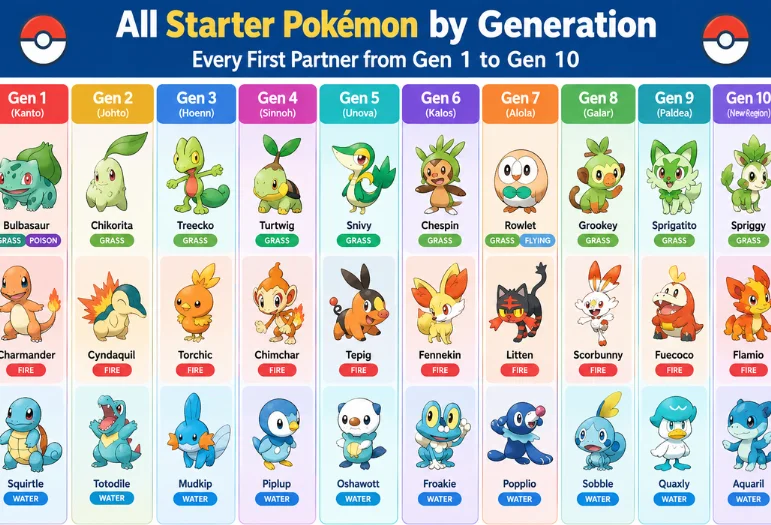
The first nine generations establish the familiar roster of 27 standard partners. Each generation introduces one Grass, Fire, and Water choice at the first stage. The table also shows each line’s final evolution for fast reference.
| Generation | Region or games | Grass starter | Fire starter | Water starter |
| Gen 1 | Kanto | Bulbasaur → Venusaur | Charmander → Charizard | Squirtle → Blastoise |
| Gen 2 | Johto | Chikorita → Meganium | Cyndaquil → Typhlosion | Totodile → Feraligatr |
| Gen 3 | Hoenn | Treecko → Sceptile | Torchic → Blaziken | Mudkip → Swampert |
| Gen 4 | Sinnoh | Turtwig → Torterra | Chimchar → Infernape | Piplup → Empoleon |
| Gen 5 | Unova | Snivy → Serperior | Tepig → Emboar | Oshawott → Samurott |
| Gen 6 | Kalos | Chespin → Chesnaught | Fennekin → Delphox | Froakie → Greninja |
| Gen 7 | Alola | Rowlet → Decidueye | Litten → Incineroar | Popplio → Primarina |
| Gen 8 | Galar | Grookey → Rillaboom | Scorbunny → Cinderace | Sobble → Inteleon |
| Gen 9 | Paldea | Sprigatito → Meowscarada | Fuecoco → Skeledirge | Quaxly → Quaquaval |
| Gen 10 | Pokémon Winds/Waves | Browt | Pombon | Gecqua |
The Gen 10 row is different because those games have not launched yet. Pokémon officially revealed the three first partners in February 2026. Their final evolutions remain unannounced as of September 2026.
What counts as a starter Pokémon?
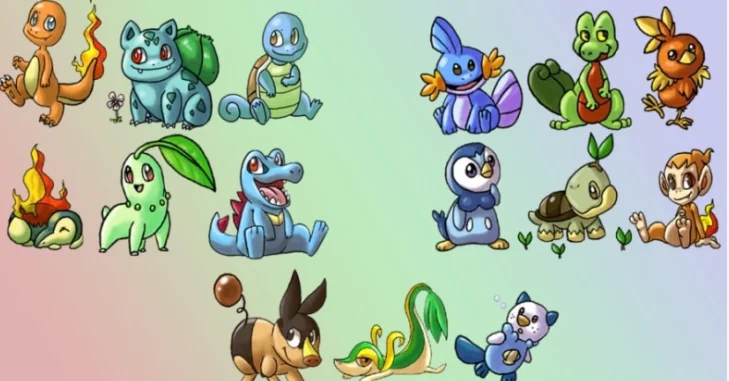
All Starter Pokémon are now commonly called “first partner Pokémon.” In traditional generations, players begin with Grass, Fire, or Water choices. That elemental structure creates an easy-to-understand relationship between the three options.
The definition gets broader when individual games change the usual formula. Legends titles can combine partners originally introduced in separate regions. Other games can make Pikachu or Eevee the player’s fixed partner instead.
This distinction matters when counting the roster. The standard generational count tracks each generation’s newly introduced trio. Game-specific partners belong in a separate group because many reuse existing species. Release coverage for those spin-offs sits alongside the rest of GamerLume’s gaming guides and news.
Special starter choices outside the standard trios
Pikachu and Eevee in Kanto games
Pikachu became the player’s special partner in Pokémon Yellow instead of using the normal three-choice opening. Pokémon: Let’s Go, Pikachu! later built its adventure around Pikachu again. Pokémon: Let’s Go, Eevee! gave Eevee the corresponding role.
The Let’s Go partners also work differently from normal captured versions. They remain alongside the player throughout the adventure and receive special partner features. The official game site confirms that your version determines whether Pikachu or Eevee becomes that partner.
Pokémon Legends: Arceus
Pokémon Legends: Arceus mixes partners from three earlier generations. Players choose Rowlet from Alola, Cyndaquil from Johto, or Oshawott from Unova. Professor Laventon brought the three species to Hisui from other regions.
Their evolutionary lines also gain a Hisuian twist. The final forms are Hisuian Decidueye, Hisuian Typhlosion, and Hisuian Samurott. These choices reuse existing starter species, so they do not increase the standard generational total.
Pokémon Legends: Z-A
Pokémon Legends: Z-A also builds a trio from earlier generations. Its first partners are Chikorita, Tepig, and Totodile. Players meet them after arriving in Lumiose City and beginning their journey.
Chikorita originally belongs to Johto, while Tepig comes from Unova. Totodile is another Johto partner from Generation 2. Their reuse creates a new game-specific trio without adding three new species.
Gen 10 starters: Browt, Pombon, and Gecqua
Pokémon Winds and Pokémon Waves introduce three completely new first partners. Browt is the Grass-type Bean Chick Pokémon. Pombon is the Fire-type Puppy Pokémon, while Gecqua is the Water-type Water Gecko Pokémon.
Browt has Overgrow, Pombon has Blaze, and Gecqua has Torrent. These abilities match the traditional ability pattern used by many earlier starters. The games are scheduled for a worldwide Nintendo Switch 2 release in 2027.
Important details are still missing before launch. Pokémon has not revealed the trio’s final evolutions on its current official game page. The new setting also has not received a traditional region name there yet.
That makes speculation about their later forms premature. Fan concepts and unofficial databases may supply possible names or designs. Those should not be treated as confirmed information until Pokémon publishes them.
How starter types change as they evolve
The first-stage pattern is simple, but final evolutions can become more complex. Many gain a second type that changes their strengths and weaknesses. That makes the original Grass, Fire, or Water label only part of the final battle profile.
Bulbasaur begins as Grass and Poison, while Venusaur keeps that combination. Mudkip eventually becomes the Water and Ground type Swampert. Piplup develops into Empoleon, which combines Water and Steel.
Later generations continue using secondary types to separate each evolutionary line. Meowscarada finishes as Grass and Dark. Skeledirge becomes Fire and Ghost, while Quaquaval ends as Water and Fighting.
Legends games can change an older line even further. Cyndaquil normally ends as Typhlosion, but Hisui gives its final form a regional variation. These changes let familiar first partners fill different roles in another game.
How many starter Pokémon are there in 2026?
There are 27 released standard first-stage choices across Generations 1 through 9. Adding the three officially announced Gen 10 newcomers brings the known standard roster to 30. Only the first 27 have appeared as released generational starters so far.
A broader count depends on what you decide to include. Pikachu and Eevee add two notable species outside the traditional generational trios. Legends selections do not raise the species total because those games reuse existing choices.
Spin-offs can make the definition even wider. For clarity, this guide focuses on traditional generations plus major official partner exceptions. That keeps the count useful instead of mixing unrelated game formats.
Which starter should you choose?
There is no universal choice that works for every Pokémon game. Early gyms, available wild Pokémon, and final typings can change a partner’s usefulness. Personal preference also matters because that Pokémon often stays on your team for many hours.
Start by checking the partner’s final evolution before choosing. Its later typing may matter more than its first-stage type. You can then build the rest of your team around weaknesses your partner cannot cover.
New players should not feel pressured to chase a perfect choice. Mainline Pokémon adventures are designed to support different teams and preferences. Picking the creature you want to keep using is a sensible starting point.
Keep exploring GamerLume
Minecraft players can also use GamerLume’s End Portal guide for progression help. The guide covers locating strongholds, activating portals, and Creative Mode builds. It is structured for quick answers and detailed walkthroughs.
For hardware advice, see the best PC controller guide. It compares current gamepads for performance, latency, battery life, and value. Use it when planning a controller upgrade for your wider gaming setup.
Frequently asked questions
What does “all starter Pokémon” include in this list?
This list includes every standard generational first partner currently revealed by Pokémon. It covers the 27 released choices from Gen 1 through Gen 9. It also includes the three officially announced Gen 10 partners coming in 2027.
Special first partners appear in their own section instead of changing the standard count. That includes Pikachu, Eevee, and the mixed-generation Legends selections. Separating those groups prevents duplicate species from inflating the number.
How many standard starter Pokémon have been released?
Nine released generations contain three standard choices each. That produces 27 released first-stage partners through Pokémon Scarlet and Pokémon Violet. Gen 10 raises the announced total to 30 but remains scheduled for 2027.
What are the Pokémon Legends: Z-A starters?
Pokémon Legends: Z-A lets players choose Chikorita, Tepig, or Totodile. These are returning species, not newly introduced Pokémon. The official game site identifies all three as first partner choices.
Chikorita and Totodile originally debuted in Generation 2. Tepig first appeared with Generation 5’s Unova trio. Their combination gives the Lumiose adventure a cross-generation starting lineup.
What are the Gen 10 starter Pokémon?
Browt, Pombon, and Gecqua are the announced Gen 10 first partners. They represent Grass, Fire, and Water, respectively. Pokémon revealed them for Pokémon Winds and Pokémon Waves in February 2026.
Their games are planned for a worldwide 2027 release. Nintendo Switch 2 is the confirmed platform. Their complete evolution lines have not been officially revealed yet.
Do all starter Pokémon begin as Grass, Fire, or Water types?
The standard generational trios follow the Grass, Fire, and Water structure. That pattern appears from Kanto through the announced Gen 10 choices. Special partner games can break the usual setup.
Pikachu is Electric-type, while Eevee is Normal-type. Both serve as partners in the corresponding Let’s Go games. Their roles show why standard and special first partners are best counted separately.